
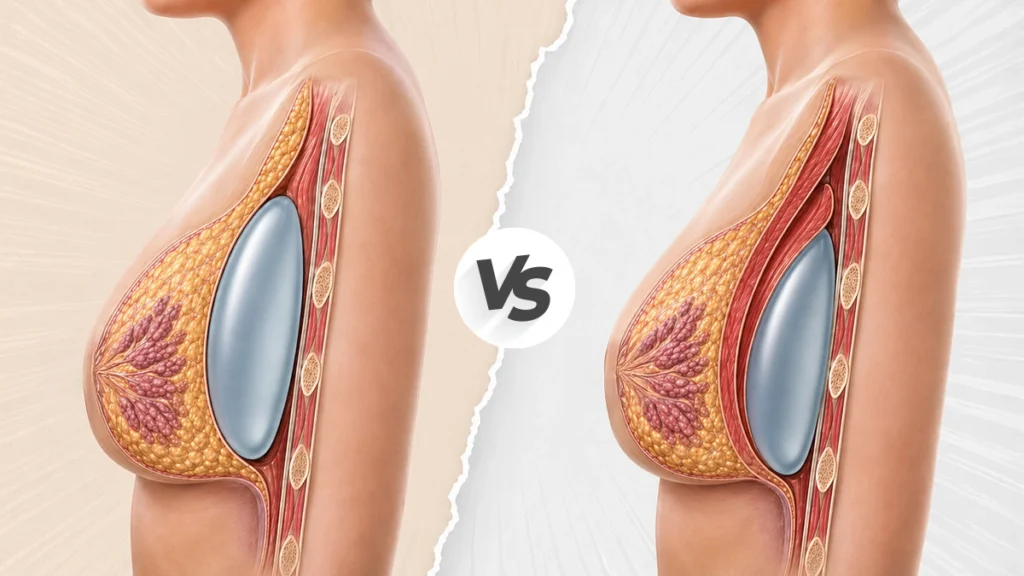
Choosing between subglandular (over the muscle) and submuscular (under the muscle) breast implants is one of the most important decisions in breast augmentation.
The placement of the implant affects not only how your results look, but also recovery time, implant movement, and long-term risks such as rippling or capsular contracture.
Understanding these differences helps you choose the approach that fits your body type and aesthetic goals.
Quick Answer: Subglandular vs Submuscular — Which Is Better?
There is no single “better” option. Subglandular implants (over the muscle) offer shorter recovery and less postoperative discomfort, while submuscular implants (under the muscle) often provide a more natural appearance and lower implant visibility in patients with thinner breast tissue. The best choice depends on body type, existing breast tissue, and surgeon recommendation.
What Is a Subglandular Breast Implant? Over the Muscle
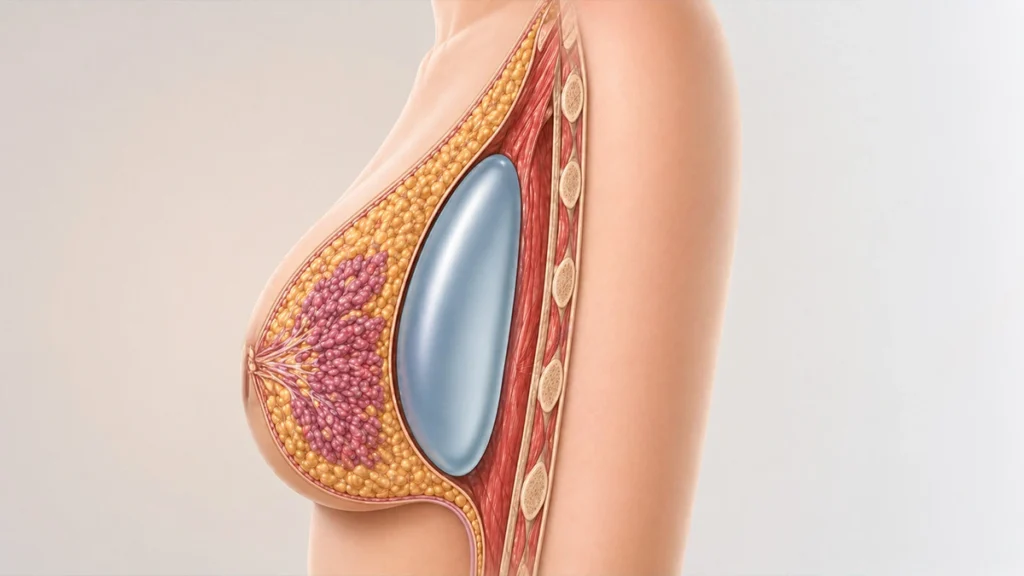
Subglandular breast implant placement means the implant is positioned behind the breast tissue but above the pectoralis chest muscle.
Implant Placement Above the Chest Muscle
In subglandular placement, the implant sits between the breast gland tissue and the pectoralis muscle. Since the muscle is not lifted to cover the implant, recovery may feel easier for some patients.
How Subglandular Implants Interact with Natural Breast Tissue
This method relies on existing breast tissue to cover the implant. When tissue coverage is good, the result can look smooth and balanced. When tissue is thin, implant edges or rippling may be more noticeable.
Subglandular Implants: Pros
Further, Subglandular implants may allow faster recovery, less muscle-related discomfort, and no implant movement caused by chest muscle contraction.
Subglandular Implants: Cons
The main downside is visibility. In thin patients or those with limited breast tissue, the implant may be easier to see or feel.
Start a Conversation
Contact us through the communication method that suits you





What Is a Submuscular Breast Implant? Under the Muscle
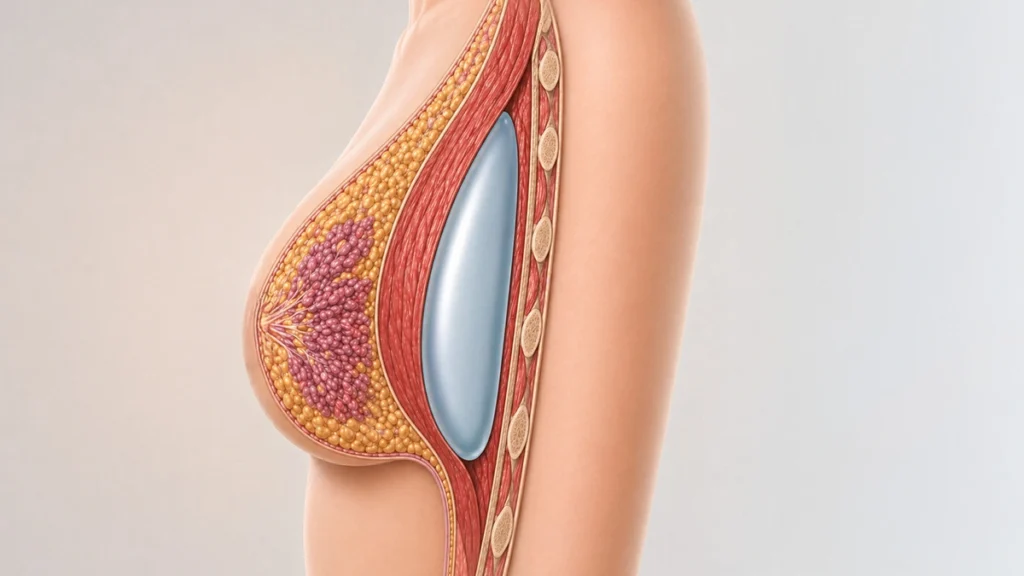
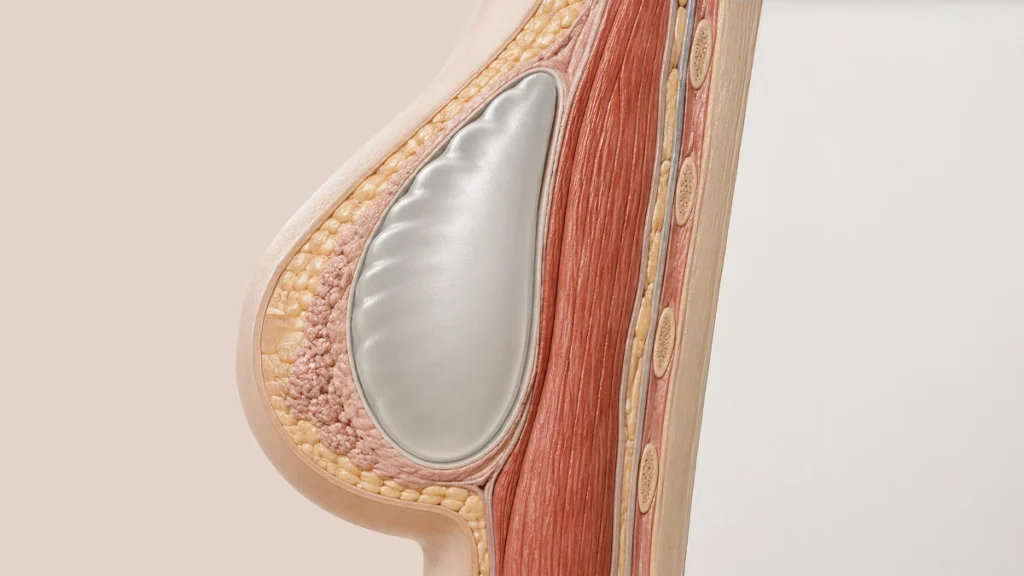
Submuscular implant placement means the implant is positioned partially or fully beneath the pectoralis muscle.
Implant Placement Under the Pectoralis Muscle
In this technique, the implant sits under the chest muscle or partly under it. Many modern procedures use a dual-plane approach, where the upper implant is covered by muscle and the lower part settles naturally.
How Muscle Coverage Affects Results
Muscle coverage can soften the upper breast contour and reduce visible implant edges. This is why submuscular placement is often preferred for patients with thinner upper breast tissue.
Submuscular Implants: Pros
Further, Submuscular implants may create a more natural slope, improve upper breast coverage, and lower the risk of visible implant edges in thin patients.
Submuscular Implants: Cons
Recovery may be longer because the chest muscle is involved. Some patients may also notice animation deformity, where the implant moves when the muscle contracts.
Subglandular vs Submuscular Breast Implants: Key Differences
The main difference is implant position. Subglandular implants sit above the muscle, while submuscular implants sit under it. This affects recovery, appearance, movement, and visibility.
Over the Muscle vs Under the Muscle Comparison
| Feature | Subglandular, Over Muscle | Submuscular, Under Muscle |
| Placement | Above the pectoralis muscle | Under the pectoralis muscle |
| Recovery | Usually faster | Usually longer |
| Natural Look | Depends on tissue coverage | Often more natural in thin patients |
| Visibility | Higher risk in thin tissue | Lower risk due to muscle coverage |
| Movement | Less affected by muscle contraction | May move with chest muscle activity |
Subglandular placement may suit patients with good tissue coverage, while submuscular placement may be better when additional coverage is needed.
Request pricing
By sending, you agree we may contact you on WhatsApp with pricing.
Got it! We’ll WhatsApp you the pricing shortly.
Recovery: Over the Muscle vs Under the Muscle Implants
After surgery, recovery depends on implant placement, implant size, incision type, surgical technique, and individual healing.
Subglandular Recovery Time
Subglandular recovery is often faster because the chest muscle is not disturbed as much. Patients may feel less tightness and discomfort during early healing.
Submuscular Recovery Time
Submuscular recovery may take longer because the muscle needs time to adapt. Patients may feel more pressure, tightness, or soreness with arm movement.
Return to Activity Timeline
Light walking is usually allowed early, but lifting, exercise, and chest workouts require surgeon approval. Submuscular patients may need more time before upper-body activity feels comfortable.
Read more: Breast Augmentation in Istanbul 2026: How to Achieve Natural-Looking Results
Which Looks More Natural?
Submuscular implants often look more natural in patients with thin tissue, but placement alone does not guarantee a natural result.
Role of Breast Tissue Thickness
Tissue thickness is one of the most important factors. Patients with enough natural tissue may achieve natural results with subglandular implants, while thinner patients may need more coverage.
Implant Edges and Visibility
Implant edges are more likely to show when tissue coverage is limited. Submuscular placement can help hide the upper implant border.
Body Type and Fat Distribution
Slim patients with low body fat may have a higher risk of implant visibility over the muscle. Patients with more natural breast volume may have enough coverage for subglandular placement.
natural results depend more on tissue coverage, implant selection, and surgical planning than placement alone.
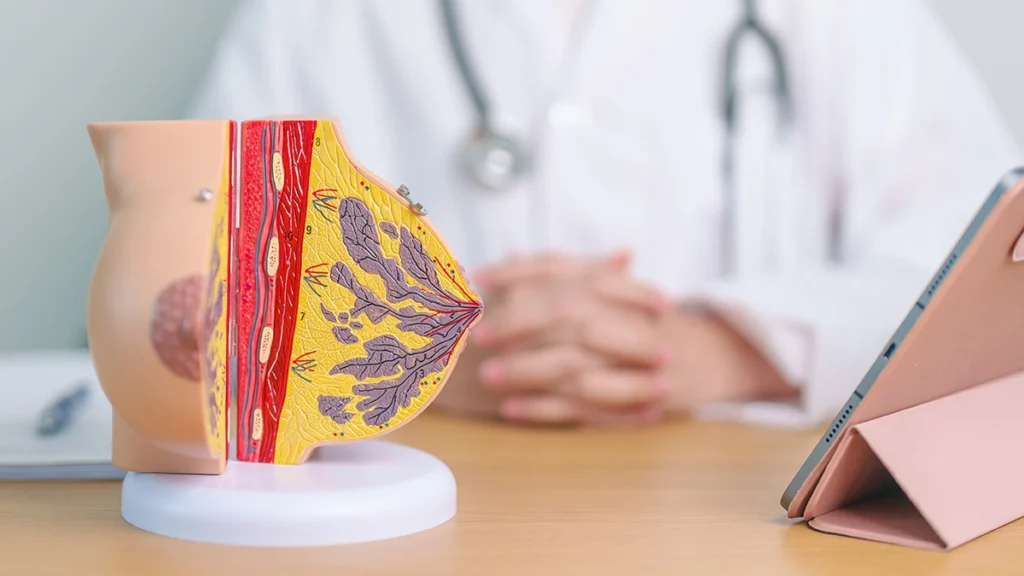
How Implant Movement Differs
Implant movement differs because one technique places the implant above the muscle, while the other places it beneath the muscle.
Subglandular Movement
Subglandular implants usually do not move with chest muscle contraction because they sit above the muscle.
Submuscular Movement
Submuscular implants may move when the pectoralis muscle contracts, especially during flexing or chest exercises.
What Is Animation Deformity?
Animation deformity is visible implant movement or distortion when the chest muscle contracts. It is linked to under-the-muscle placement.
Risks and Complications
Both techniques carry possible risks, including pain, bleeding, infection, sensation changes, implant malposition, rippling, capsular contracture, and future revision surgery.
Rippling: More Common Over the Muscle
Rippling is more likely when the implant is not well covered by tissue, especially in thin patients with subglandular placement.
Animation Deformity: Under the Muscle
Animation deformity is mainly associated with submuscular placement because the implant sits beneath the active chest muscle.
Implant Visibility and Edges
Visible implant edges are more common when tissue coverage is limited. Submuscular placement may reduce this risk by adding muscle coverage.
Capsular Contracture
Capsular contracture happens when scar tissue around the implant tightens and causes firmness, discomfort, or shape changes. Risk depends on implant placement, surgical technique, implant type, healing, and patient factors.
Risk Comparison
| Risk | Subglandular | Submuscular |
| Rippling | Higher risk in thin patients | Lower risk due to added coverage |
| Animation deformity | Not usually present | Possible |
| Implant visibility | Higher risk with thin tissue | Lower risk |
| Capsular contracture | May be slightly higher in some cases | May be lower in some cases |
This table is a general guide, not a personal risk prediction.
Who Is a Better Candidate for Each Placement?
The better candidate depends on body frame, breast tissue thickness, chest anatomy, activity level, and desired result.
Best Candidates for Subglandular Implants
Subglandular implants may suit patients with enough natural breast tissue to cover the implant. They may also suit patients who prefer faster recovery or want to avoid muscle-related implant movement.
Best Candidates for Submuscular Implants
Submuscular implants may be better for thin patients, patients with minimal breast tissue, or those at higher risk of visible implant edges.
When Surgeon Recommendation Is Critical
Surgeon recommendation is especially important in revision surgery, breast asymmetry, thin tissue, complex anatomy, or when large implants are being considered.
Surgeon Decision Factors: What Really Determines Placement
Implant placement should be based on clinical planning, not preference alone.
Body Type and Anatomy
Chest width, breast base width, rib shape, shoulder frame, and tissue thickness all influence placement choice.
Skin Elasticity
Skin quality affects how the breast adapts to implant volume and how the final shape settles.
Desired Aesthetic Outcome
Some patients want subtle fullness, while others want more visible volume. Placement should support the goal while respecting anatomy.
Implant Size and Type
Implant volume, profile, shape, and material all affect whether over-the-muscle or under-the-muscle placement is more suitable.
Request pricing
By sending, you agree we may contact you on WhatsApp with pricing.
Got it! We’ll WhatsApp you the pricing shortly.
Questions to Ask Your Surgeon
- Which implant placement suits my body type?
- What are the risks in my case?
- How will recovery differ?
- Will implant movement be noticeable?
- What happens if revision surgery is needed?
These questions can help you understand which implant placement is safer, more suitable, and more predictable for your body type.
Read more: Breast Augmentation in Istanbul 2026: Implants vs Fat Transfer Explained
People Also Ask
- Is subglandular or submuscular better?
- Do submuscular implants look more natural?
- Which has faster recovery: over or under the muscle?
- What is animation deformity?
- Can implant rippling be avoided?
Here are the most common questions patients ask when comparing over-the-muscle and under-the-muscle breast implants.
Final Insight: There Is No One-Size-Fits-All Answer
Subglandular and submuscular implants can both create attractive results when chosen for the right patient. Subglandular placement may offer faster recovery, while submuscular placement may provide better coverage and a more natural contour in thinner patients. The best results in Turkey depend on anatomy, tissue coverage, implant selection, and personalized surgical planning.
Which treatment are you interested in?
FAQ
There is no universal best option. It depends on anatomy, goals, tissue coverage, and surgeon recommendation.
They often provide a more natural slope, especially in patients with less natural breast tissue.
Yes. Subglandular implants usually involve faster recovery and less muscle-related discomfort.
Animation deformity is visible implant movement when the chest muscle contracts.
They can be more visible in patients with thin breast tissue or limited implant coverage.
Yes. Rippling can happen with breast implants, especially with over-the-muscle placement in thin patients.