
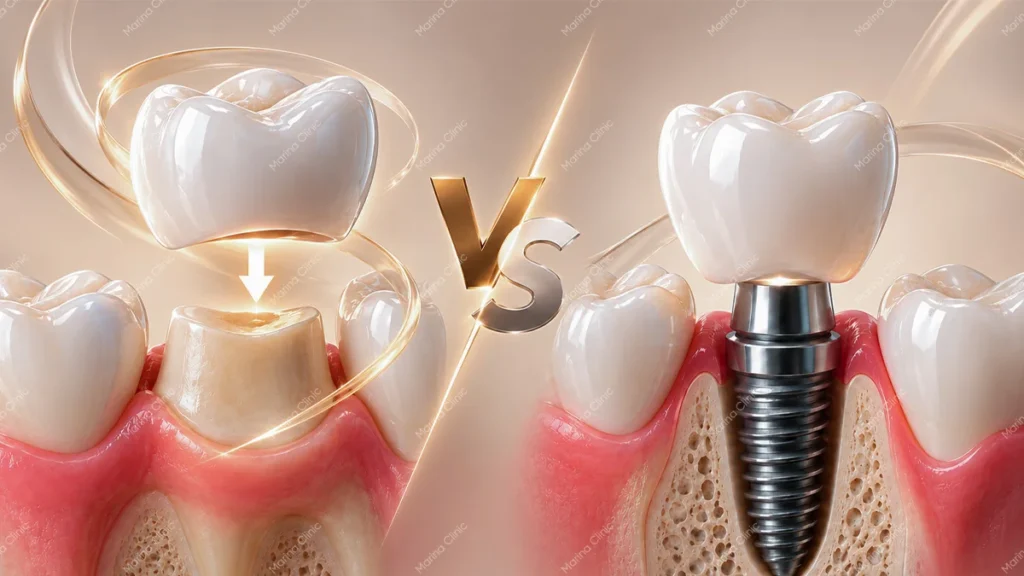
A severely damaged tooth does not always need to be removed. In many cases, a dental crown can preserve it, while other situations require extraction and replacement with a dental implant. The decision depends on how much healthy tooth remains, the condition of the root, gum and bone support, previous treatment, and the expected long-term outcome.
Should You Choose a Dental Crown or a Dental Implant?
A dental crown and a dental implant serve different purposes. A crown is used when the natural tooth can still be predictably preserved, while an implant replaces a missing tooth or one that cannot be restored. Dentists assess tooth structure, root condition, bone support, gum health, and long-term prognosis before recommending treatment.
Dental Crown vs Implant: What Is the Difference?
The main difference is whether the natural tooth remains. A crown covers and strengthens an existing tooth, while an implant is placed into the jawbone to support a replacement tooth after tooth loss or extraction.
When a Crown Is Used
A dental crown may be used when a damaged tooth still has enough healthy structure and root support. It restores the tooth’s shape, protects weakened areas, and helps maintain normal function.
When May a Dental Implant Be Considered?
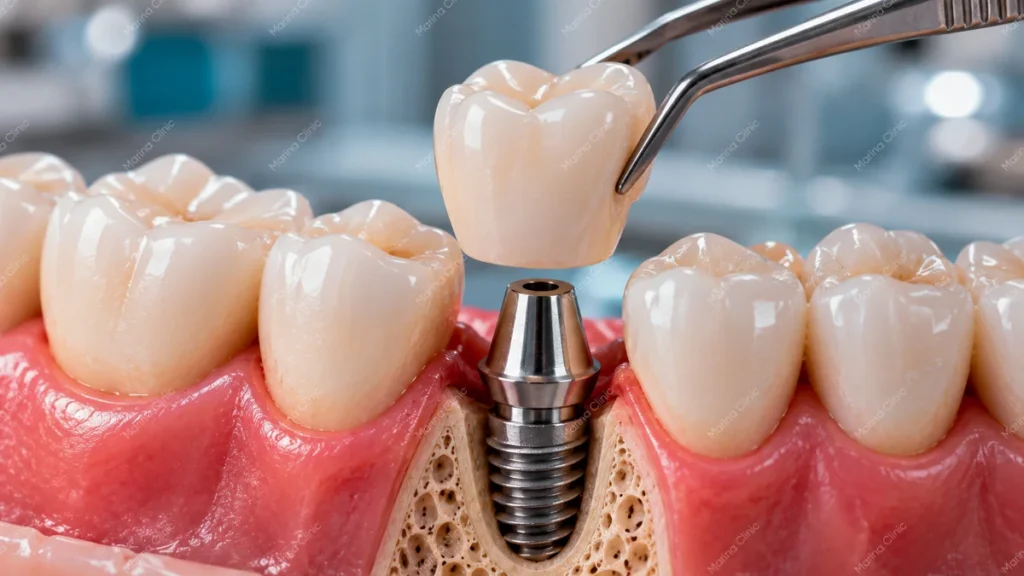
A dental implant may be considered when a tooth is missing or cannot be restored predictably. The implant acts as an artificial root and supports an abutment and dental crown.
Why Saving the Natural Tooth Is Often Preferred When Possible
Preserving a restorable natural tooth avoids extraction and implant surgery while maintaining the natural root and surrounding tissues. However, preservation is worthwhile only when the tooth has a reasonable long-term prognosis.
Start a Conversation
Contact us through the communication method that suits you





When Can a Tooth Be Saved With a Dental Crown?
A damaged tooth does not automatically require removal. Dentists first assess whether enough healthy structure remains and whether the root and surrounding tissues can support a durable restoration.
Cracked Teeth
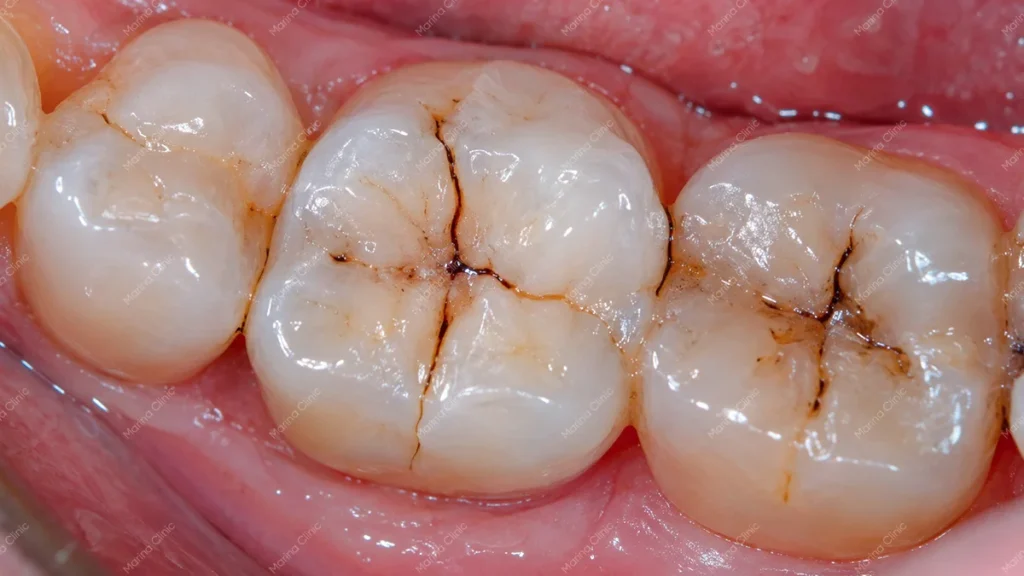
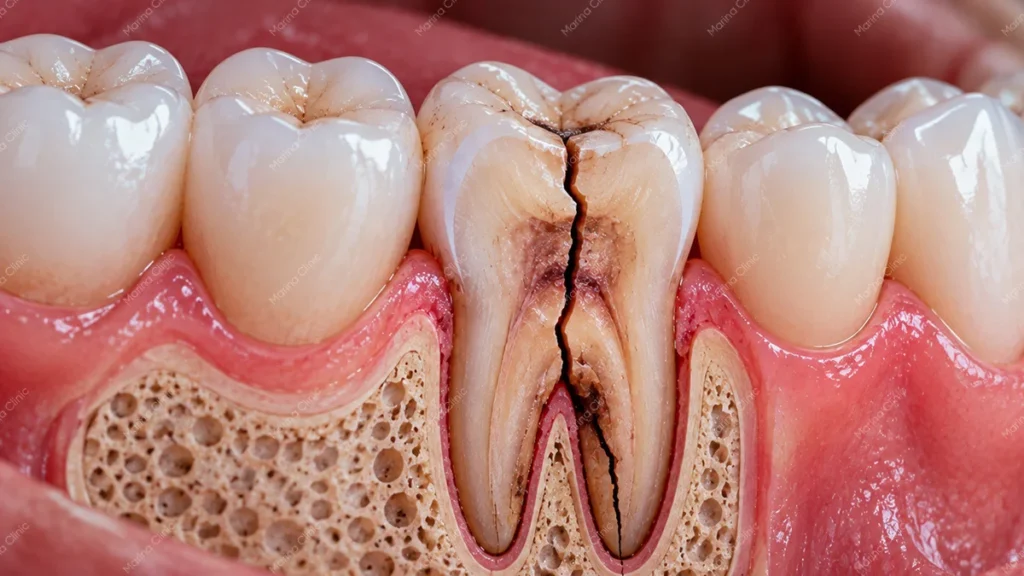
Some cracked teeth can be protected with a crown if the crack has not extended deeply into the root. Severe vertical root fractures, however, may make the tooth impossible to restore.
Teeth With Large Fillings
Large fillings can leave limited natural tooth structure and increase fracture risk. When enough healthy structure remains, a crown can provide greater support than another large filling.
Root Canal-Treated Teeth
Root canal-treated teeth often have reduced tooth structure because of previous decay, restorations, fractures, or treatment access. A crown or another suitable restoration may therefore be recommended for protection.
Teeth With Sufficient Remaining Structure
A crown requires enough healthy tooth structure for support. If decay, fractures, or previous treatment have removed too much of the tooth, additional procedures or another treatment may be necessary.
When Is a Dental Implant the Better Option?
An implant becomes an option when the natural tooth cannot be predictably preserved or has already been lost. Dentists evaluate the reason for tooth loss, available bone, gum health, and overall treatment needs first.
Missing Teeth
When a tooth is already missing, an implant can replace its root without relying on neighboring teeth. Once integrated with the bone, it can support an individual dental crown.
Teeth That Cannot Be Restored
Severe decay or damage may extend too far below the gum line for a predictable crown. In these cases, extraction followed by implant treatment may be considered.
Root Fractures
A vertical root fracture can greatly reduce the chance of saving a tooth. When the fracture makes restoration impossible, extraction and implant treatment may be considered if the site is suitable.
Failed Previous Dental Treatment
Previous root canals, posts, or crowns do not automatically mean a tooth must be extracted. An implant may become appropriate when repeated treatment has failed and the tooth no longer has a predictable prognosis.
Dental Crown vs Implant: Pros and Cons
Crowns and implants solve different problems. A crown preserves an existing tooth, while an implant replaces a tooth that is missing or cannot be maintained.
Function
A well-planned crown can restore chewing when the natural tooth and root remain stable. An implant-supported crown can also restore function after tooth loss with proper bite planning.
Aesthetics
Both treatments can provide natural-looking results. Crown aesthetics depend partly on the underlying tooth, while implant aesthetics also depend on implant position, bone volume, gum shape, and crown design.
Tooth Preservation
A crown preserves the natural root and remaining healthy tooth structure. Implant treatment requires the tooth to be absent or extracted, so a restorable tooth is not usually removed simply for an implant.
Long-Term Maintenance
Both treatments require daily hygiene and professional care. Crowns can develop decay around their margins, while implants can develop inflammation and bone loss in the surrounding tissues.
Treatment Time
A crown is often completed faster when extensive treatment is unnecessary. Implant therapy often takes longer because it may involve extraction, healing, implant placement, integration, and the final restoration.
| Factor | Dental Crown | Dental Implant |
| Natural tooth | Preserved | Tooth is missing or removed |
| Surgery | Usually not required | Implant surgery required |
| Treatment time | Often shorter | Usually longer |
| Main purpose | Restore a damaged tooth | Replace a missing tooth |
| Decay risk | Tooth beneath crown can decay | No tooth decay |
| Maintenance | Brushing, flossing, check-ups | Brushing, interdental cleaning, check-ups |
| Additional treatment | May require root canal or build-up | May require extraction or bone grafting |
Upload your photos and receive a free AI-powered preliminary analysis in minutes. No commitment required.
Crown vs Implant Cost: What Influences the Final Price?
Comparing crown vs implant cost requires looking at the full treatment plan. Saving a tooth may involve additional restorative procedures, while implant treatment may include surgical and restorative stages.
Crown and Core Build-Up
A heavily damaged tooth may need a core build-up before crown placement. This replaces missing tooth structure and provides a suitable foundation for the final crown.
Root Canal Treatment
If the pulp is infected or severely inflamed, root canal treatment may be required before the crown. This additional procedure can increase the total cost of saving the tooth.
Tooth Extraction
When a tooth cannot be preserved, extraction becomes part of implant treatment. Its complexity depends on factors such as root shape, fracture, infection, and surrounding bone.
Implant Surgery
Implant placement involves positioning the implant within the jawbone. Site complexity, the implant system, imaging, and surgical needs can influence the final cost.
Abutment and Final Crown
The implant itself is only one part of the restoration. An abutment connects it to the visible dental crown, and both are included in the complete implant-supported tooth.
Bone Grafting When Needed
Insufficient jawbone volume may leave too little support for an implant. In these cases, a bone graft may be needed before or during implant placement, which can increase treatment complexity and overall cost.
Request pricing
By sending, you agree we may contact you on WhatsApp with pricing.
Got it! We’ll WhatsApp you the pricing shortly.
Which Lasts Longer: A Crown or a Dental Implant?
There is no fixed lifespan for either treatment. Both can function for many years, depending on treatment quality, supporting tissues, bite forces, oral habits, hygiene, and regular maintenance.
Factors That Affect Crown Longevity
Crown longevity depends on remaining tooth structure, material, preparation, bite forces, decay risk, grinding, and oral hygiene. The health of the tooth underneath remains especially important.
Factors That Affect Implant Longevity
Implant longevity depends on bone support, gum health, implant position, bite forces, smoking, hygiene, and maintenance. The implant may remain stable even if the crown later needs repair or replacement.
The Importance of Oral Hygiene and Regular Maintenance
Neither treatment is maintenance-free. Plaque can contribute to decay and gum disease around teeth and to inflammation around implants, making daily care and routine examinations important.
Read more: How Long Do Dental Implants Last? Brands, Costs, and What Affects Longevity
Upload your photos and receive a free AI-powered preliminary analysis in minutes. No commitment required.
Should You Replace an Old Crown or Choose an Implant?
An old or damaged crown does not automatically mean the tooth should be extracted. Dentists first assess the restoration and underlying tooth to determine whether another crown is possible.
Recurrent Decay
Decay can develop around or beneath an older crown. If it can be removed while leaving enough healthy tooth structure, the tooth may still be restored with a new crown.
Root Fractures
A root fracture can significantly change the treatment plan because some fractures make restoration impossible. Its location and direction help determine whether the tooth can be saved.
Repeated Crown Failure
Repeated crown failure may indicate decay, bite problems, limited tooth structure, or root issues. The cause should be identified before deciding whether another crown is appropriate.
Remaining Tooth Structure
The amount of healthy tooth remaining is central to the decision. A crown needs a stable foundation, while very limited structure may reduce the predictability of another restoration.
Gum and Bone Support
A repairable tooth still needs healthy periodontal support. Significant gum disease, mobility, or bone loss can reduce its long-term prognosis.
Front Tooth Crown vs Implant: What Changes the Decision?
When comparing a front tooth dental crown vs implant, appearance, gum support, bone levels, and the condition of the natural tooth all influence the decision. Preserving a restorable front tooth is often preferred, while an implant can replace a tooth that cannot be saved.
Smile Aesthetics
A front crown should match nearby teeth in shade, shape, and translucency. With a dental implant, aesthetics also depend on precise implant position and the shape of the surrounding soft tissue.
Gum Line
The position and symmetry of the gum line can strongly affect the result of a crown vs implant treatment. Dentists consider gum thickness, recession, inflammation, and the appearance of neighboring teeth.
Bone Preservation
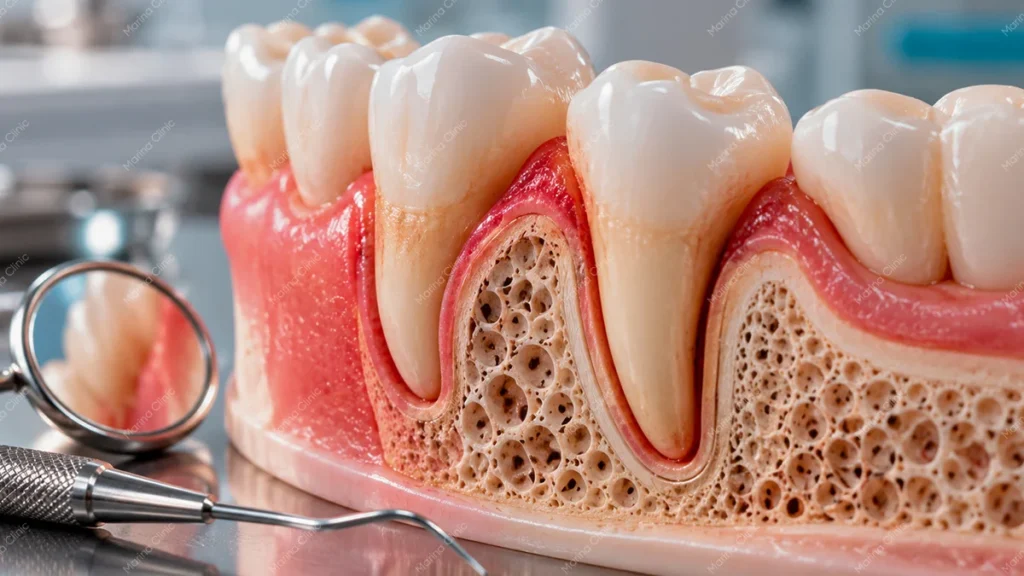
Natural tooth roots help support the surrounding bone, although bone levels can still change over time. After extraction, careful implant planning and bone-preservation techniques may help maintain the site.
Why Preserving a Natural Front Tooth Is Often Preferred
When a front tooth has a stable root and can be predictably restored with a crown, preserving it helps maintain the natural relationship between the tooth, gum, and bone.
Read more: Dental Implants Before and After: Real Patient Cases and Treatment Plans
How Does a Dentist Decide Between a Crown and an Implant?
Choosing between a crown and an implant requires more than examining the visible tooth. Dentists combine clinical findings, imaging, dental history, bite assessment, and patient priorities.
Clinical Examination
The dentist examines the tooth for decay, cracks, mobility, damaged restorations, gum problems, and remaining healthy structure. The bite and neighboring teeth are also assessed.
X-Rays and CBCT
Dental X-rays reveal roots, surrounding bone, previous treatment, and hidden problems. CBCT imaging may be used when three-dimensional information is needed for diagnosis or implant planning.
Root Condition
A tooth with a healthy or treatable root may remain suitable for restoration. Deep fractures, severe root damage, or persistent problems after treatment can reduce its prognosis.
Bone and Gum Health
Both crowns and implants depend on healthy supporting tissues. Dentists assess gum inflammation, periodontal disease, bone levels, and tissue quality before treatment.
Long-Term Prognosis
The dentist considers whether treatment is likely to provide stable function over time, not simply whether the tooth can technically be repaired.
Patient Goals and Preferences
Treatment decisions also consider treatment time, maintenance expectations, aesthetics, medical history, and budget alongside the clinical findings.
Read more: Dental Implants Price in Turkey – Full Guide
Which Option Is Right for Your Tooth?
The right treatment depends on whether the existing tooth offers a reliable foundation for restoration. A crown can protect a damaged but restorable tooth, while an implant provides a replacement when the tooth is missing or cannot be predictably maintained.
Why Every Case Is Different
Two teeth with similar visible damage may require completely different treatments because the roots, bone support, fractures, decay depth, and previous dental work can differ. This is why photographs or symptoms alone cannot determine whether a crown or implant is appropriate.
The Importance of a Personalized Treatment Plan
A personalized plan weighs the benefits of preserving the natural tooth against the predictability of replacing it. Clinical examination and appropriate imaging allow the dentist to identify the option that supports function, oral health, aesthetics, and realistic long-term maintenance.
Which treatment are you interested in?
FAQs
Whenever a tooth can be predictably restored, preserving the natural tooth is often preferred. If it cannot be saved, an implant may provide a suitable replacement.
A crown restores a damaged natural tooth, while an implant replaces the root of a missing tooth and supports a new restoration.
Both can provide long-term function. Longevity depends on tooth or implant health, bite forces, hygiene, restoration quality, and regular dental maintenance.
Implant treatment often has a higher initial cost because it may involve extraction, surgery, an abutment, and a final crown.
No. Restorability depends on the remaining tooth structure, root condition, fracture depth, periodontal support, and overall long-term prognosis.
An implant may be considered when the underlying tooth has severe decay, an unrestorable fracture, major structural loss, or another problem preventing predictable restoration.
If a front tooth can be predictably preserved, keeping it is often preferred. When replacement is necessary, implant positioning and gum support become especially important.
Dentists assess tooth structure, roots, gums, bone, imaging, bite forces, previous treatment, and long-term prognosis before recommending an appropriate option.