
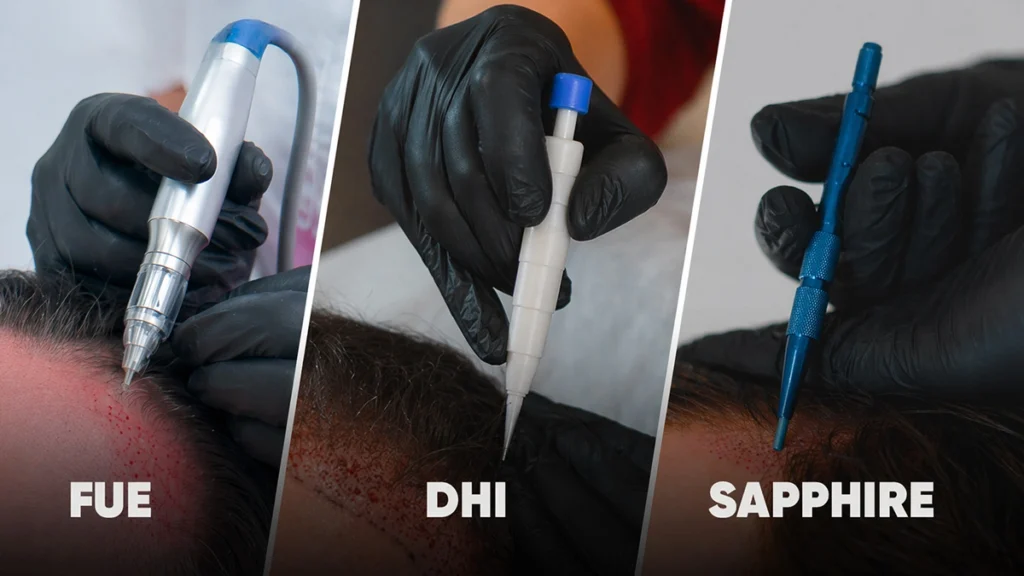
Choosing between FUE, DHI, and Sapphire FUE can feel confusing at first. Most patients hear different opinions from different clinics, and each technique is often presented as “the best.” In reality, the best hair transplant technique depends on your hair loss pattern, donor area, graft number, and the result you want to achieve.
FUE is usually preferred when a patient needs wider coverage. DHI is often better for hairline design and smaller detailed areas. Sapphire FUE is a refined version of FUE that can help with dense packing, smaller incisions, and smoother healing.
So the real question is not “Which technique is best?” The better question is: which technique is best for your hair, your donor area, and your long-term result?
Quick Answer: Which Hair Transplant Technique Is Better in 2026?
There is no single “best” hair transplant technique. FUE is ideal for large areas (3000–5000 grafts), DHI offers high precision for hairline design, and Sapphire FUE improves density and healing. The right choice depends on donor area health, hair loss pattern, and desired density.
What Are Hair Transplant Techniques in 2026?
Hair transplant techniques are the methods used to move healthy hair follicles from the donor area to thinning or bald areas. The donor area is usually the back and sides of the scalp because these hairs are more resistant to genetic hair loss.
In 2026, the most common modern techniques are FUE, DHI, and Sapphire FUE. All three can give natural results when they are planned properly. The difference is how the grafts are extracted, how the recipient area is prepared, and how the follicles are implanted.
Why Technique Selection Matters
The technique affects how the result looks, how the scalp heals, and how safely the donor area is used.
| Factor | Why It Matters |
| Density | Affects how full the transplanted area looks |
| Healing | Influences redness, scabbing, swelling, and downtime |
| Natural appearance | Depends on angle, direction, spacing, and hairline design |
| Donor safety | Helps prevent overharvesting and patchy donor thinning |
A good hair transplant is not only about placing as many grafts as possible. It is about using the available grafts wisely.
Overview of Modern Methods
FUE is commonly used for larger areas because it allows a higher number of grafts in suitable patients.
DHI is used when precision is more important than volume, especially in the hairline.
Sapphire FUE follows the FUE method but uses sapphire blades to create more refined channels.
When comparing FUE and Sapphire vs DHI, the best choice depends on whether the patient needs coverage, precision, dense packing, or a combination of all three.
What Is FUE Hair Transplant?
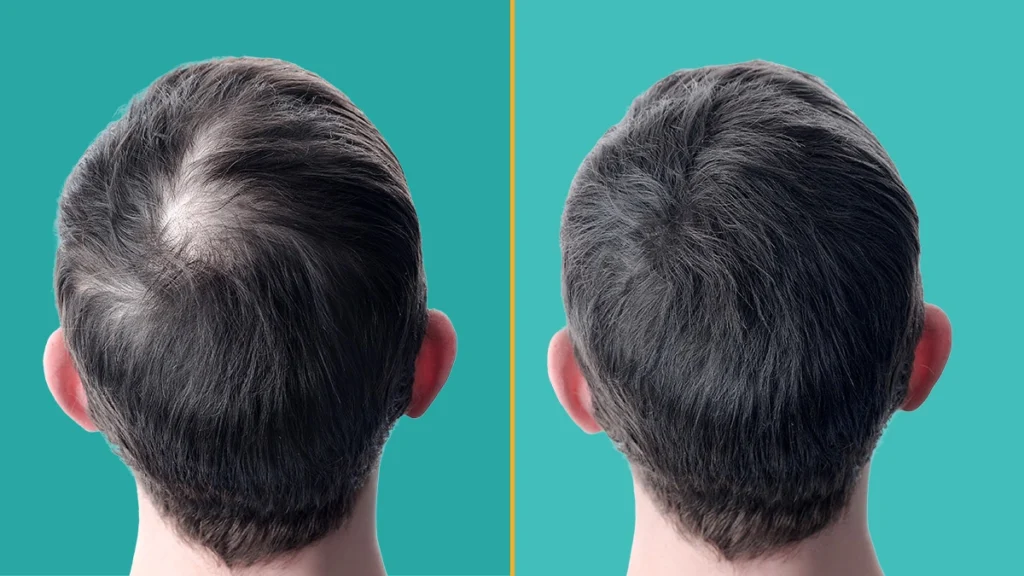
FUE, or Follicular Unit Extraction, is a modern hair transplant technique used to restore thinning or bald areas. It works by taking individual hair grafts from the donor area, usually the back and sides of the scalp, and placing them where more density is needed.
Unlike older strip methods, FUE does not involve removing a piece of skin from the scalp. Because of this, it does not leave a long linear scar, making it a popular option for patients who want a natural result with a less invasive approach.
How FUE Hair Transplant Works
FUE hair transplant is performed step by step to move healthy hair follicles from the donor area to the areas with thinning or baldness.
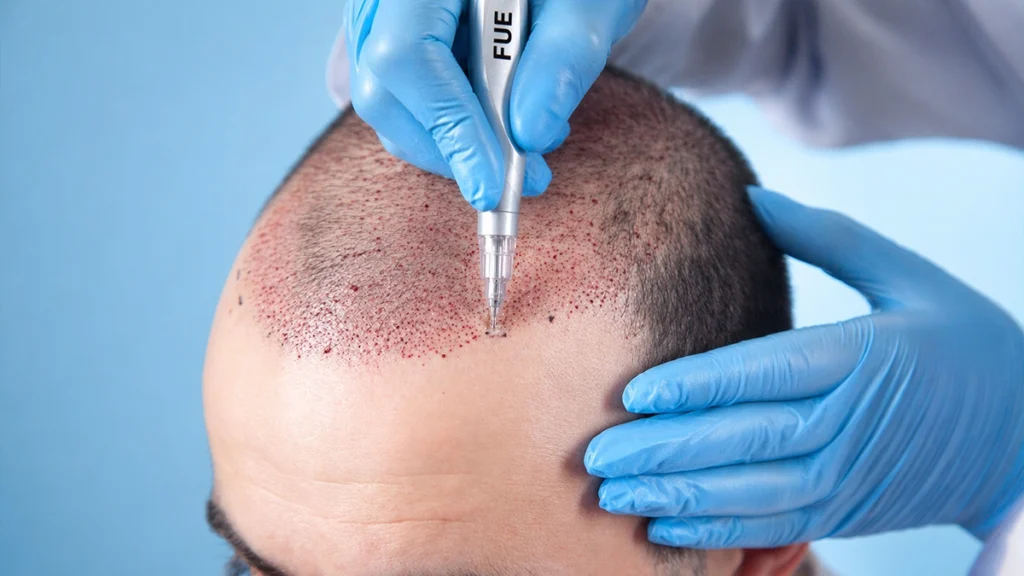
First, the surgeon carefully extracts individual hair grafts from the donor area using a small punch tool.
Next, tiny channels are created in the thinning or bald area. These channels are important because they guide the angle, direction, and depth of the transplanted hair.
Finally, the grafts are placed into the prepared channels to build natural-looking coverage and density.
When FUE Is Recommended
FUE is often recommended for patients who need a larger number of grafts. It can be a good option for people with thinning in the front, mid-scalp, crown, or multiple areas.
FUE may be suitable for:
- Large areas of hair loss
- 3000 to 5000 graft cases
- Crown restoration
- Mid-scalp thinning
- Patients who want to avoid a linear scar
Advantages of FUE
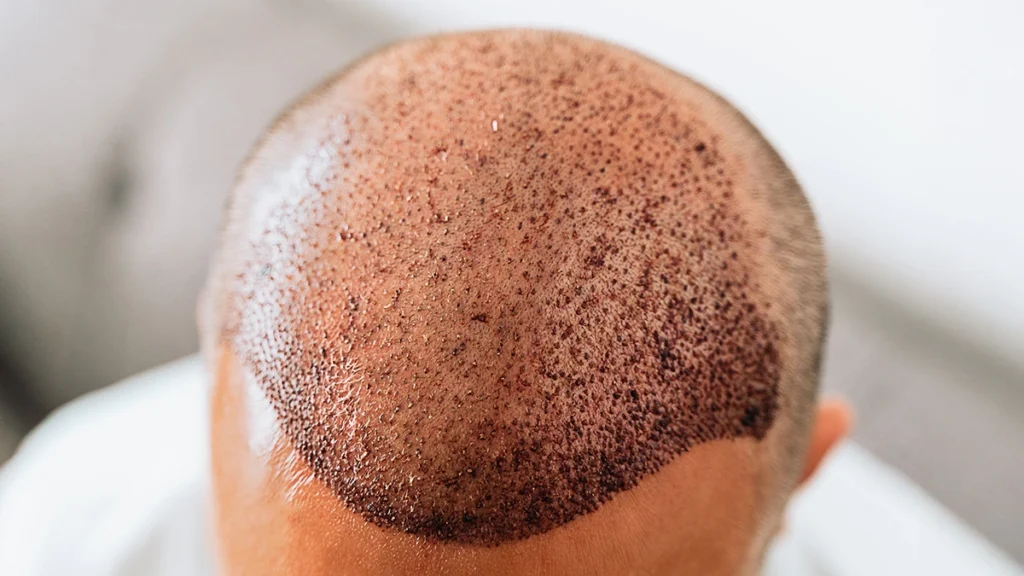
The biggest advantage of FUE is coverage. It can treat larger areas when the donor area is strong enough.
FUE also gives flexibility. It can be used for the hairline, crown, beard, and other areas in selected cases.
Another benefit is that it does not leave a long scar, which is important for patients who prefer shorter hairstyles.
Limitations of FUE
FUE may not offer the same level of placement control as DHI in very detailed hairline cases. It also depends heavily on donor quality.
If too many grafts are taken from the donor area, the back of the scalp can look thin or uneven. This is why safe donor planning is essential.
What Is DHI Hair Transplant?
DHI stands for Direct Hair Implantation. It is often used for patients who need more precise graft placement, especially in the frontal hairline.
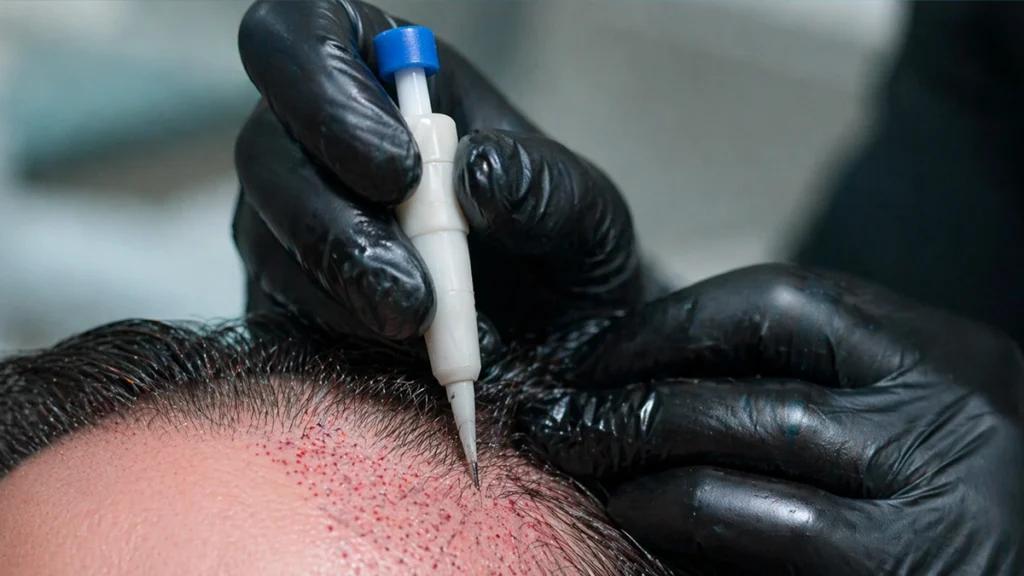
The grafts are usually extracted using the FUE method, but the implantation step is different. Instead of opening all channels first, the grafts are placed using a special implanter pen, often called a Choi pen.
How DHI Differs from FUE
The main difference between FUE and DHI is how the grafts are implanted.
With standard FUE, the channels are opened first, then the grafts are placed into those channels.
With DHI, the graft is loaded into the implanter pen and inserted directly into the scalp. This gives more control over the angle, depth, and direction of each follicle.
When DHI Is Preferred
DHI is often preferred when the treatment area is smaller but highly visible.
It may be suitable for:
- Hairline restoration
- Temple correction
- Frontal density
- Small to medium areas
- Implanting between existing hairs
DHI is especially useful when the main goal is a soft, natural-looking hairline.
Advantages of DHI
The main advantage of DHI is precision.
The front hairline needs careful planning because it frames the face. If the hairline is too straight, too low, or too dense at the edge, the result can look unnatural.
DHI allows more control during placement, which can help create a softer and more realistic hairline.
Limitations of DHI
DHI is not always the best choice for large bald areas. It can take longer than FUE and may not be practical for very high graft numbers.
For patients who need 4000 to 5000 grafts, FUE or Sapphire FUE is usually more suitable. In some cases, clinics combine methods: DHI for the hairline and FUE or Sapphire FUE for larger areas.
Read more: Hair Transplant Turkey 2026: Why Turkey Leads the World (FUE, DHI, Sapphire & Costs Explained)
Start a Conversation
Contact us through the communication method that suits you





What Is a Sapphire FUE Hair Transplant?
Sapphire FUE is a refined version of FUE. The extraction process is similar to standard FUE, but the recipient channels are created using sapphire blades instead of traditional steel blades.
The goal is to create smaller, cleaner, and more precise incisions.
Why Sapphire Is a Variation of FUE
Sapphire FUE is not a completely separate hair transplant method. It is still based on FUE extraction.
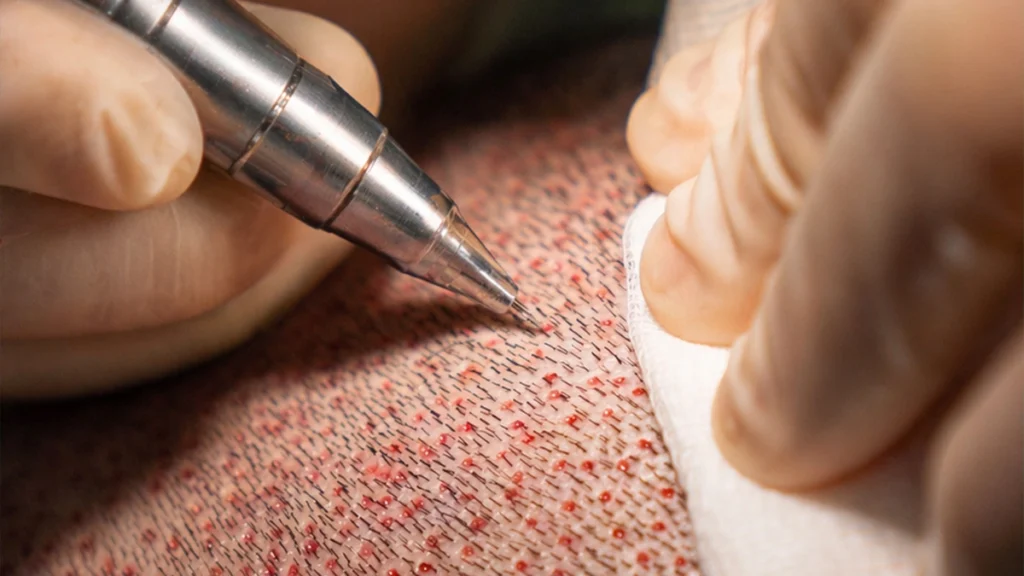
The difference is in the channel-opening stage. Sapphire blades allow the surgeon to make more precise recipient sites, which may help with graft placement, density, and healing.
What Sapphire Blades Improve
Smaller Incisions
Sapphire blades can create smaller channels in the recipient area. Smaller incisions may reduce tissue trauma and support a smoother recovery.
Less Tissue Trauma
Cleaner channels may lead to less redness, swelling, and scabbing after surgery.
Better Density Packing
Because the channels are more precise, Sapphire FUE may allow closer graft placement in suitable patients. This makes it a strong option for patients who want good coverage with improved density.
Read more: Hair Transplant Turkey vs Europe 2026: Medical Standards, Cost & Techniques Compared
FUE vs DHI vs Sapphire Hair Transplant: Which Is Better for You?
The best technique depends on what needs to be treated.
A patient with a wide bald crown usually needs a different plan from someone who only wants a refined frontal hairline. A patient with a strong donor area may be able to receive more grafts than someone with limited donor density.
Main Differences Between Techniques
| Feature | FUE | DHI | Sapphire FUE |
| Best For | Large areas | Hairline | Dense packing |
| Graft Capacity | 3000 to 5000 in suitable cases | Moderate | High in suitable cases |
| Precision | Good | Very high | High |
| Healing | Standard | Moderate | Often faster |
| Hairline Design | Good | Excellent | Very good |
| Crown Coverage | Good | Limited for large cases | Very good |
| Cost | Usually lower | Usually higher | Mid to high |
In simple terms, FUE is best for coverage, DHI is best for precision, and Sapphire FUE is best for dense FUE cases with improved healing.
Which Technique Gives Better Density and Healing?
Density and healing are not decided by technique alone. They also depend on donor strength, graft quality, surgeon experience, and aftercare.
Still, each technique has its own strengths.
Density Results by Technique
DHI can provide excellent density in the hairline and frontal area because each graft is placed with high control.
Sapphire FUE may support dense packing because the channels can be smaller and more accurate.
FUE gives reliable density across larger areas, especially when the patient needs coverage more than detailed hairline work.
The best density does not always mean using the highest number of grafts. It means placing the right grafts in the right areas.
Healing Comparison
Sapphire FUE often has smoother healing because of smaller and cleaner incisions.
DHI can also be gentle on the recipient area when performed correctly.
Standard FUE has a normal recovery process, including redness, scabbing, swelling, and temporary shedding.
Most patients can return to normal daily activities within a short period, but full hair growth takes several months.
How Many Grafts Do You Need? 3000 to 5000 Grafts Explained
The number of grafts depends on the size of the thinning area, donor density, hair thickness, hair color, and desired result.
Two patients may have the same level of hair loss but need different graft numbers because their hair quality is different.
1000 to 2000 Grafts
This range is usually used for smaller corrections, such as:
- Hairline refinement
- Temple filling
- Small frontal gaps
DHI is often a good option here because precision matters more than graft volume.
3000 to 4000 Grafts
This range is common for moderate hair loss. It may be used for the front and mid-scalp, or for crown improvement in selected cases.
FUE and Sapphire FUE are often preferred for this range because they allow broader coverage.
4000 to 5000 Grafts
This range is usually needed for advanced hair loss. It may involve the frontal area, mid-scalp, and crown.
Best Technique for High Graft Cases
For high graft cases, FUE or Sapphire FUE is usually preferred. DHI may still be used for the hairline, but FUE or Sapphire FUE is often more practical for larger coverage.
Read more: Hair Transplant in Istanbul 2026: Techniques, Results & What to Expect
Request pricing
By sending, you agree we may contact you on WhatsApp with pricing.
Got it! We’ll WhatsApp you the pricing shortly.
Donor Area Health: The Key Factor in Choosing Technique
The donor area is the foundation of the result. If the donor area is weak, no technique can create unlimited density.
What Is the Donor Area?
The donor area is usually the back and sides of the scalp. These hairs are more resistant to genetic hair loss, so they are used for transplantation.
However, donor hair is limited. Once grafts are removed, they do not grow back in the donor area.
How Donor Density Affects Results
A strong donor area gives the surgeon more options. A weak donor area limits how many grafts can be safely extracted.
Before choosing a technique, the clinic should check:
- Donor density
- Hair thickness
- Scalp condition
- Miniaturization
- Previous hair transplant history
- Future hair loss risk
Risks of Overharvesting
Overharvesting happens when too many grafts are taken from the donor area. This can make the back of the scalp look thin, patchy, or uneven.
A safe hair transplant plan should improve the visible bald areas without damaging the donor area.
Read more: Hair Transplant in Turkey 2026: Costs, Techniques, Results & Expected Hairline
Crown vs Hairline: Which Technique Works Best?
The crown and hairline are very different areas, so they usually need different planning.
Crown Area Hair Loss
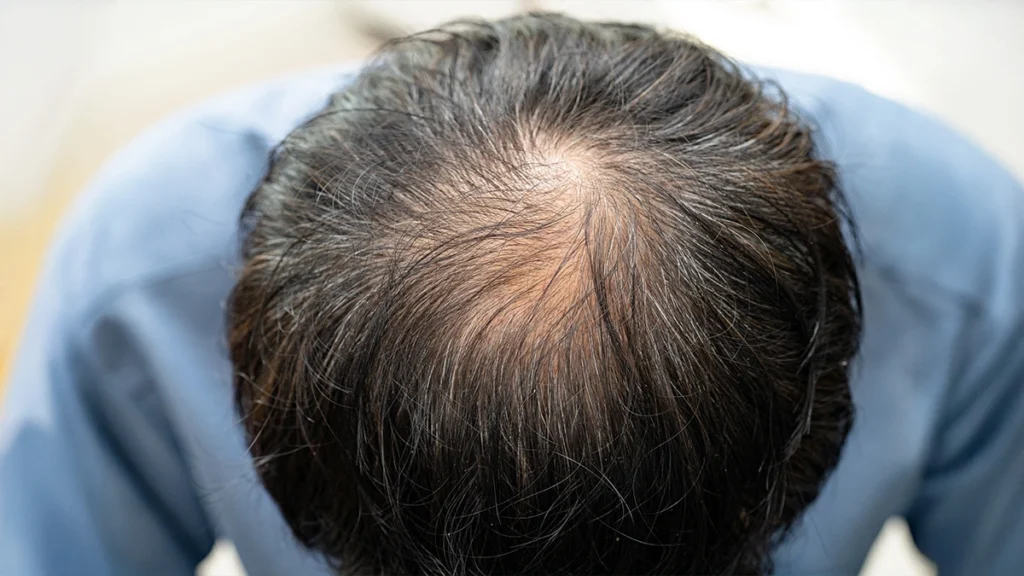
The crown often needs more grafts because the hair grows in a circular pattern. It can be harder to create the look of density in this area.
FUE or Sapphire FUE is usually recommended for crown restoration because these techniques can manage higher graft numbers.
Hairline Restoration
The hairline needs more precision than almost any other area.
It should look soft, natural, and slightly irregular. A hairline that looks too straight or too dense at the front can look artificial.
DHI is often preferred for hairline restoration because it gives better control over angle, depth, and direction.
Who Is the Best Candidate for Each Technique?
The best candidate is chosen after a proper consultation, not from the technique name alone.
Best Candidates for FUE
FUE may be best for patients who:
- Need large coverage
- Have moderate to advanced hair loss
- Need 3000 to 5000 grafts
- Have a strong donor area
- Want no linear scar
Best Candidates for DHI
DHI may be best for patients who:
- Need hairline correction
- Have small to medium hair loss
- Want detailed frontal design
- Need grafts placed between existing hairs
- Prefer precision over maximum graft volume
Best Candidates for Sapphire FUE
Sapphire FUE may be best for patients who:
- Want dense packing
- Need larger coverage
- Want smoother healing
- Have a strong enough donor area
- Want a balance between coverage and precision
FUE vs DHI Hair Transplant: Which Is Better?
FUE and DHI are both effective, but they are not used for the same goal.
When FUE Is Better
FUE is usually better when the patient needs a large number of grafts. It is commonly used for the crown, mid-scalp, and advanced hair loss.
When DHI Is Better
DHI is usually better when the patient needs detailed work in a visible area. It is often used for hairline design, temple correction, and frontal density.
When Sapphire FUE Is the Best Choice
Sapphire FUE may be the best choice when the patient needs FUE coverage but also wants better channel precision, dense packing, and smoother healing.
For many patients, the best plan may combine techniques. For example, DHI can be used for the hairline, while Sapphire FUE is used for the larger areas behind it.
Start a Conversation
Contact us through the communication method that suits you
Hair Transplant Results: What to Expect
Hair transplant results take time. The transplanted hair does not grow fully right after surgery.
Timeline of Results
| Time After Surgery | What Usually Happens |
| First week | Redness, swelling, and scabbing |
| 2 to 4 weeks | Temporary shedding |
| 3 to 6 months | Early growth begins |
| 6 to 9 months | Density improves |
| 12 months | Most final results appear |
| 12 to 18 months | Crown results may continue improving |
Density Expectations by Technique
DHI can create strong frontal density in suitable cases. Sapphire FUE can help with dense packing and healing. FUE can provide reliable coverage for larger areas.
The final density depends on donor capacity. No technique can safely create more hair than the donor area can provide.
Read more: Hair Transplant Cost in Turkey: Techniques, Prices & Choice Guide
People Also Ask About FUE vs DHI vs Sapphire
Which hair transplant is better FUE or DHI?
Is Sapphire FUE better than standard FUE?
How many grafts do I need?
Which technique gives best density?
Is DHI more expensive than FUE?
Final Answer: Which Hair Transplant Technique Is Best for You?
There is no universal best hair transplant technique in 2026.
If your main concern is the hairline, DHI is often the better option because it gives more control over angle, depth, and direction.
If you have crown hair loss or a larger bald area, FUE or Sapphire FUE is usually more suitable because these techniques can manage higher graft numbers.
If you want dense packing with smoother healing, Sapphire FUE may offer the best balance between coverage and refinement.
The technique matters, but the treatment plan matters more. A good plan protects the donor area, creates a natural hairline, uses grafts wisely, and considers future hair loss.
Which treatment are you interested in?
FAQ
The best technique depends on your hair loss pattern, donor area, graft number, and desired density.
DHI is better for hairline precision. FUE is better for larger areas and higher graft numbers.
Sapphire FUE is a refined FUE technique that uses sapphire blades to create more precise recipient channels.
Most patients need between 2000 and 5000 grafts, depending on the size of the thinning area and donor strength.
FUE or Sapphire FUE is usually preferred for crown hair loss because the crown often needs more grafts.
DHI is often preferred for hairline restoration because it allows better control over angle, depth, and direction.
Sapphire FUE may offer smaller incisions, improved dense packing, and smoother healing in suitable patients.
Yes. Some patients benefit from DHI for the hairline and FUE or Sapphire FUE for larger areas.
DHI is often more expensive because it takes more time and uses specialized implantation tools.
FUE, DHI, and Sapphire FUE can all be safe when performed by an experienced medical team with proper donor planning.