
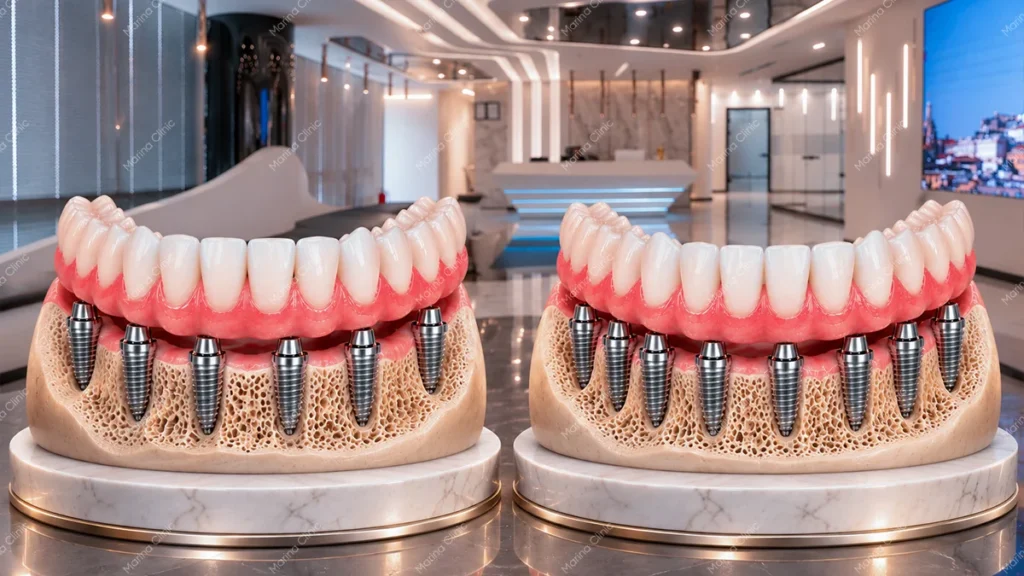
All-on-6 and All-on-8 dental implants are popular options for replacing a full arch of missing teeth with a fixed bridge. Although both treatments restore chewing function and smile appearance, they differ in implant number, cost, and surgical requirements. Understanding these differences can help patients choose the most suitable treatment.
Is All-on-8 Better Than All-on-6 Dental Implants?
All-on-6 uses six dental implants to support a fixed full-arch restoration, while All-on-8 uses eight implants. All-on-8 may offer additional support points in suitable cases, but more implants do not automatically mean better stability or longer-lasting results. The best option depends on available bone, implant distribution, bite forces, prosthetic design, and treatment complexity. All-on-8 generally costs more because it requires additional implants and potentially more extensive surgery.
All-on-6 vs All-on-8 Dental Implants: What Is the Difference?
The main difference between All-on-6 and All-on-8 dental implants is the number of implants supporting the fixed restoration. Both replace an entire arch of missing teeth, but All-on-8 uses two additional implants that may offer advantages in selected clinical cases.
| Feature | All-on-6 | All-on-8 |
| Implants per arch | 6 | 8 |
| Restoration | Fixed full-arch bridge | Fixed full-arch bridge |
| Implant distribution | Six support points | Eight support points |
| Bone requirements | Adequate bone at six positions | Adequate bone at eight positions |
| Surgical complexity | Depends on anatomy | May involve more implant sites |
| Relative implant cost | Generally lower | Generally higher |
| Best suited for | Cases adequately supported by six implants | Cases where eight implants offer a planning advantage |
How Implant Number Affects Full-Arch Support
Implant number influences how chewing forces are distributed across the supporting bone. Six well-positioned implants can provide sufficient support for many full-arch restorations, while eight may offer additional support points when clinically appropriate.
Why More Implants Are Not Always Better
More implants do not necessarily mean better results. Six strategically positioned implants may function as effectively as eight, depending on bone quality and bridge design. Additional implants can also increase surgical complexity and cost without providing a significant benefit.
Start a Conversation
Contact us through the communication method that suits you





What Are All-on-6 and All-on-8 Dental Implants?
All-on-6 and All-on-8 are fixed full-arch dental implant treatments for patients missing most or all their teeth. Instead of placing an implant for every tooth, both techniques use multiple implants to support a complete bridge in the upper or lower jaw.
How All-on-6 Dental Implants Work
All-on-6 uses six strategically placed dental implants to support a fixed bridge. The implants integrate with the jawbone and provide a stable foundation for replacement teeth. This approach is suitable when six implants can adequately support the planned restoration.
How All-on-8 Dental Implants Work
All-on-8 follows the same principle but uses eight implants distributed across the jaw. The additional implants may provide more support points and help distribute chewing forces in selected cases, provided sufficient bone is available for placement.
What Do Both Treatments Have in Common?
Both treatments restore a complete arch with a fixed implant-supported bridge. They involve examination, surgical placement, healing, and final restoration. Both also require good oral hygiene and regular dental maintenance for long-term success.
All-on-6 vs All-on-8 Cost in Turkey: What Determines the Total Price?
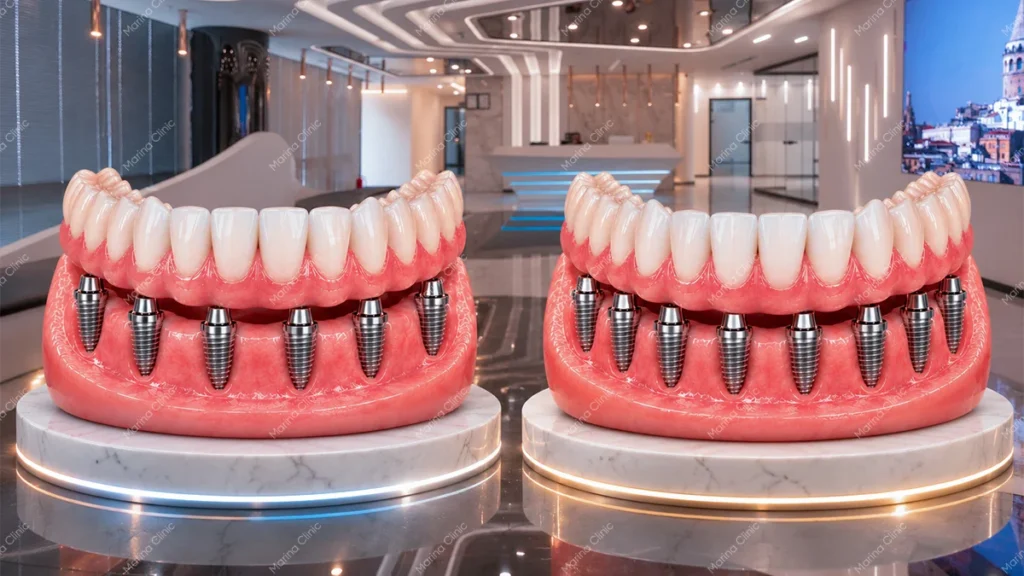
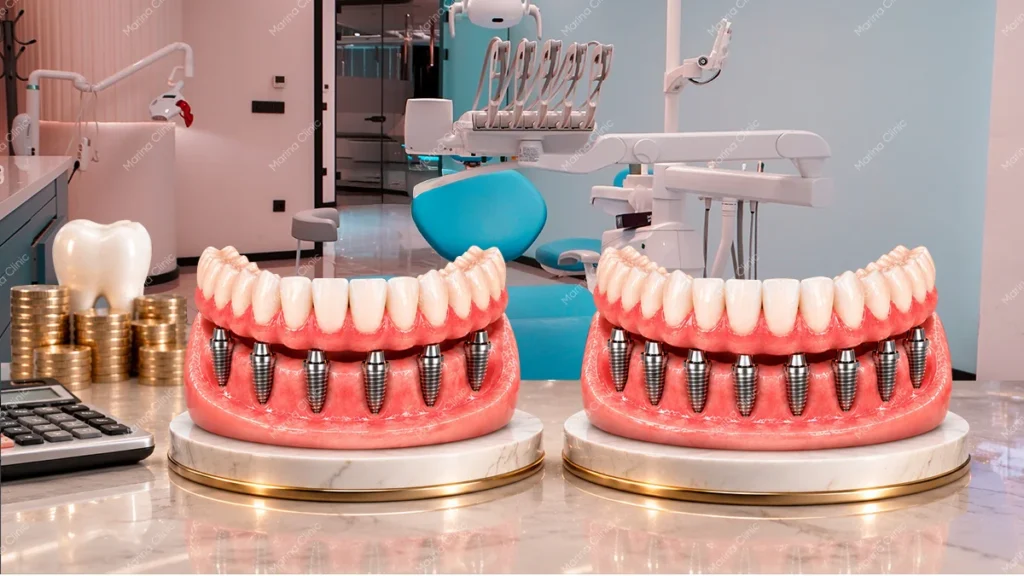
The cost of All-on-6 and All-on-8 dental implants in Turkey depends on the number and brand of implants, restoration materials, and additional procedures. All-on-8 generally costs more because two additional implants are placed per arch, although the final price depends on the individual treatment plan.
Cost Per Arch vs Full Mouth Treatment
Implant prices may be quoted per arch or for full-mouth treatment. A single-arch price covers either the upper or lower jaw, while full-mouth dental implants typically involve both jaws. Patients should confirm exactly what their quotation includes.
Implant Number and Brand
All-on-8 typically involves higher implant and component costs because it requires eight implants instead of six. The chosen implant brand also affects pricing, particularly through component quality, clinical documentation, and long-term availability of replacement parts.
Temporary Teeth and Final Bridge Materials
Temporary bridges are commonly made from acrylic-based materials, while final restorations may use zirconia, acrylic, or composite. These materials differ in appearance, durability, repair options, and price. Patients should confirm whether both temporary and final teeth are included.
Additional Costs: Extractions, Bone Grafting, and Sedation
Some patients require tooth extractions, bone grafting, sinus procedures, or sedation before or during implant placement. These treatments can increase costs and affect the schedule, depending on the patient’s oral health and bone conditions.
What Should Be Included in an Implant Package?
Before comparing dental implant packages in Turkey, patients should request a detailed quotation covering:
- Consultation, CBCT scans, and treatment planning
- Implant number, brand, and prosthetic components
- Extractions or bone grafting, if required
- Temporary teeth and final bridge materials
- Sedation, medication, and postoperative care
- Follow-up appointments and warranty conditions
- Accommodation or transfers, if included
Request pricing
By sending, you agree we may contact you on WhatsApp with pricing.
Got it! We’ll WhatsApp you the pricing shortly.
All-on-6 vs All-on-8 Procedure: How Many Visits and How Long Does Treatment Take?
All-on-6 and All-on-8 follow similar treatment stages. For patients traveling to Turkey, treatment often involves an initial surgical visit and a later visit for the final bridge. The exact schedule depends on bone healing, implant stability, and any additional procedures.
Initial Consultation and CBCT Planning
The dentist examines the patient’s oral health and uses CBCT imaging to assess bone volume, anatomical structures, and potential implant positions. These findings help determine whether six or eight implants are suitable.
Implant Placement and Temporary Teeth
During surgery, the dentist places the planned implants, sometimes following tooth extractions. Temporary fixed teeth may be fitted soon after surgery if implant stability allows immediate loading. Otherwise, a delayed restoration approach may be necessary.
Healing and Osseointegration
After placement, the implants gradually integrate with the surrounding jawbone through osseointegration. Healing usually takes several months, depending on bone conditions and individual recovery. The final bridge is fitted once the implants are ready.
Final Bridge Placement and Bite Adjustments
The final implant-supported bridge is designed to fit the implants and the patient’s bite. During placement, the dentist checks comfort, function, appearance, and cleaning access, making adjustments where necessary.

Upload your photos and receive a free AI-powered preliminary analysis in minutes. No commitment required.
Does All-on-8 Provide More Stability Than All-on-6?
All-on-8 may offer additional support points, but this does not automatically make it more stable than All-on-6. Stability depends on implant positioning, bone quality, bite forces, and prosthetic design rather than implant number alone.
Implant Distribution and Bone Support
Implants must be positioned to support the bridge and distribute chewing forces effectively. Six properly distributed implants may provide adequate support, while eight may be beneficial when additional implant positions improve the overall design.
Bite Forces and Prosthetic Design
Strong bite forces and teeth grinding can place additional stress on implant-supported bridges. Implant placement, bridge materials, and bite alignment all influence how these forces are managed, regardless of whether six or eight implants are used.
Can Additional Implants Improve Load Distribution?
Eight implants may help distribute chewing forces across more support points in selected cases. However, the advantage depends on implant positions, bridge rigidity, and bone conditions, so additional implants are not always necessary.
Why Eight Implants Do Not Guarantee Better Results
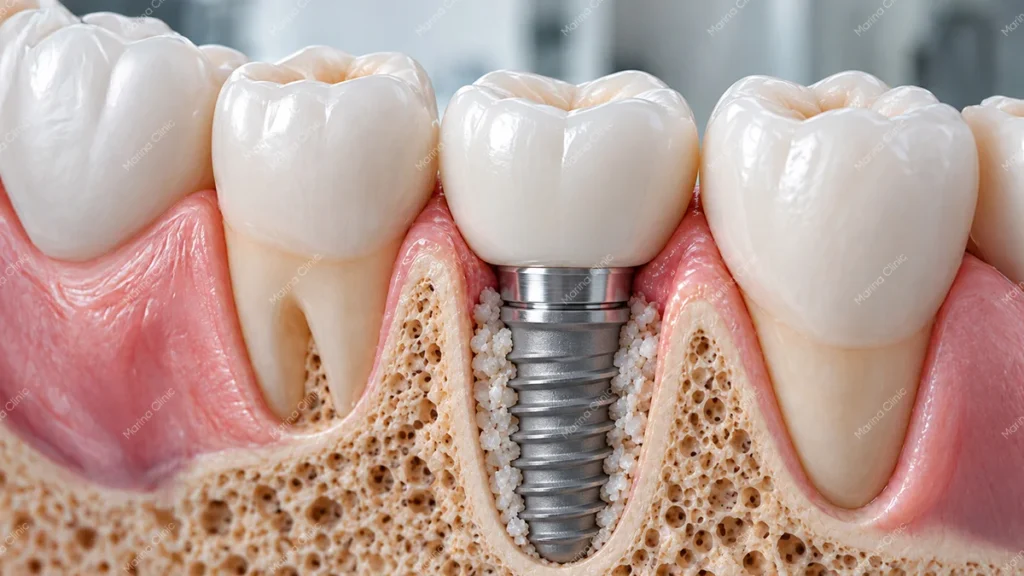
Long-term implant success depends on healthy bone and gums, accurate placement, appropriate bridge design, and regular maintenance. Eight implants cannot eliminate risks such as inflammation, bone loss, or mechanical complications.
Which Is Better for Full-Mouth and Full-Arch Dental Implants?
Both All-on-6 and All-on-8 can restore a complete dental arch, but neither is universally better. The most suitable option depends on the patient’s missing teeth, bone availability, jaw anatomy, and functional requirements.
Patients With All Teeth Missing
Patients missing all teeth in one or both jaws may qualify for either treatment. When six well-positioned implants provide adequate support, placing eight may not offer an additional clinical advantage.
Patients With Severely Damaged or Failing Teeth
Patients with damaged or failing teeth may require extractions before implant treatment. The remaining bone, infection status, and planned bridge determine whether All-on-6 or All-on-8 is appropriate.
Upper Jaw vs Lower Jaw Treatment
The upper and lower jaws have different bone densities and anatomical structures. The upper jaw often has softer bone, while the lower jaw requires careful consideration of nerve positions. These factors influence implant placement and number.
Patients With Bruxism or High Bite Forces
Patients who grind or clench their teeth may need additional planning to manage increased mechanical stress. Bridge design, implant distribution, bite adjustments, and protective night guards may be considered rather than simply adding more implants.
Patients With Limited Bone Availability
Bone loss can limit suitable implant positions. Some patients may qualify for All-on-6, while placing eight implants may require additional bone support. CBCT assessment helps determine whether grafting or alternative treatment is needed.
Read more: Full Mouth Dental Implants in Istanbul: Cost and Treatment Process
Upload your photos and receive a free AI-powered preliminary analysis in minutes. No commitment required.
Do Implant Brands and Bridge Materials Affect All-on-6 or All-on-8 Treatment?
Implant brands, prosthetic components, and bridge materials influence the quality and maintenance of both treatments. Choosing suitable materials and compatible components is important for function, appearance, and long-term care.
How Implant Systems Influence Treatment Planning
Implant systems differ in dimensions, connection designs, and available restorative components. These differences affect placement options, bridge compatibility, and future maintenance requirements.
Titanium Implants and Original Prosthetic Components
Titanium implants are widely used because of their established clinical performance and ability to integrate with bone. Compatible, manufacturer-approved prosthetic components help support reliable connections and simplify future maintenance.
Zirconia vs Acrylic or Composite Bridges
Zirconia bridges offer strength and wear resistance, while acrylic and composite restorations provide different repair and maintenance options. The best material depends on bite forces, available space, aesthetic goals, and budget.
Laboratory Accuracy and Long-Term Maintenance
A well-fitting bridge supports comfortable function and reduces the risk of certain mechanical problems. Accurate laboratory work, regular checkups, and proper cleaning are important for maintaining both All-on-6 and All-on-8 restorations.
All-on-6 or All-on-8: How Does a Dentist Decide Which Is Right for You?
The dentist selects the appropriate implant configuration after reviewing the patient’s anatomy, oral health, restorative needs, and treatment goals. The decision focuses on achieving reliable support rather than using the highest possible number of implants.
Bone Quantity, Quality, and CBCT Findings
CBCT imaging helps assess bone volume, quality, and suitable implant positions. If six implants can provide adequate support, placing eight may not be necessary or anatomically appropriate.
Bite Forces and Remaining Teeth
The dentist evaluates chewing forces, bite alignment, and the condition of any remaining teeth. These findings help determine implant positioning and whether additional support points would provide a meaningful advantage.
Prosthetic Space and Restoration Design
The available space between the jaws influences bridge thickness, material choice, and implant positioning. Treatment planning must ensure that the final restoration fits comfortably and functions effectively.
Medical History, Treatment Budget, and Long-Term Goals
Medical conditions, smoking, oral hygiene habits, and financial considerations can influence treatment selection. The dentist should explain the benefits, limitations, and maintenance requirements of each suitable option.
Read more: All-on-4 vs All-on-6 Dental Implants in Turkey: Which Option Is Right for You?
Final Verdict
All-on-6 and All-on-8 dental implants are both options for replacing a full arch of missing teeth with a fixed restoration. While All-on-8 provides two additional implant support points, this does not automatically make it the better or more durable treatment. The most appropriate choice depends on bone anatomy, implant distribution, bite forces, prosthetic materials, and the patient’s overall treatment needs.
At Marina Clinic in Istanbul, Turkey, patients considering All-on-6 or All-on-8 dental implants can undergo an individualized full-mouth assessment to determine the most suitable implant configuration. Treatment planning considers clinical findings, restorative goals, and long-term maintenance requirements rather than implant count alone.
Which treatment are you interested in?
FAQs
Not necessarily. All-on-8 provides additional support points, but the better option depends on bone quality, implant positions, and prosthetic planning. Six well-positioned implants may provide sufficient support.
All-on-8 generally costs more because it requires two additional implants per arch, increasing surgical and component expenses. The implant brand and bridge material also influence pricing.
Both treatments can replace an entire upper or lower arch of missing teeth with a fixed bridge. The final number of replacement teeth depends on the prosthetic design.
Eight implants may improve support distribution in selected cases, but strength also depends on bone quality, implant positioning, bite forces, and bridge materials.
Possibly. Suitability depends on the amount and location of remaining bone. Some patients may need bone grafting or an alternative implant configuration.
Both treatments commonly involve separate visits for implant surgery and final bridge placement. The number of visits depends on healing, implant stability, and additional procedures.
Neither treatment has a guaranteed longer lifespan. Longevity depends on implant health, oral hygiene, bridge quality, bite forces, and regular professional maintenance.
The dentist evaluates CBCT scans, available bone, bite forces, restorative requirements, medical history, and treatment goals to determine the most suitable implant number.


